


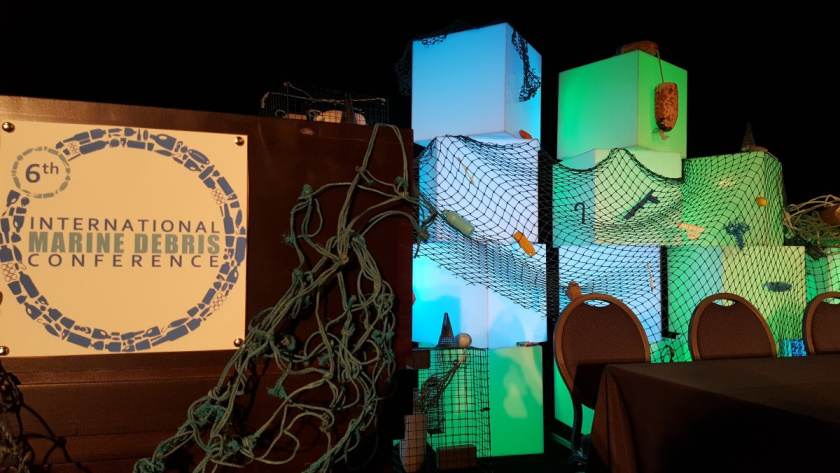
The 6th International Conference on Marine Debris (6IMDC) held in San Diego in March 2018 brought together major stakeholders comprised of environmental organisations, industry, researchers, artists as well as politicians. Many of the most renowned and respected people who address this issue were present. There was a buzz and bustle of activity all week and a fantastic atmosphere, which was inspiring and challenging if not tiring. A 5 day conference is a marathon of impressions and information. It was, however, a good chance to make some connections and gather information. The conference itself had an overwhelmingly interesting program. It was very well coordinated and participants were encouraged not to use disposable plastics. The conference itself was as disposable plastic free as possible. As an important actor both historically and presently with regards to the issue of marine litter, it is important for KIMO to participate in international events such as this.
Summary:
• KIMO’s Fishing for Litter project generates international interest as a viable project that can be replicated
• There are many good resources available online for education and research on marine litter (links below)
• Marine Litter art is fascinating and could be used to set focus on the issue at conferences and events
• Local and international cooperations such as the Global Ghost Gear Initiative remain key to tackling the problem of marine litter
• Research from the Trash-Free Waters Project could help municipalities reduce land based inputs of litter.
• A study of wooden drifters from Germany can show how litter moves around in the North Sea area
• Many studies at the municipal level that were presented could be replicated in KIMO municipalities including a campaign to reduce balloons as marine debris
• Clean Sea Life – an initiative to adopt a beach area and conduct regular clean-ups – is similar to the Green Deal approach being undertaken by KIMO municipalities in the Netherlands and deserves wider dissemination
• Knowledge of the paraffin pollution problem is not widespread although key sector figures such as Jan van Franeker have observed the effects of paraffin pollution firsthand
• The amount of research that is being carried out especially on microplastics has greatly increased since the last IMDC in Hawaii 6 years ago. The level of awareness and citizen involvement about marine litter/marine plastics has also increased.
Sessions
Each session featured up to 6 presentations and some days there were up to 4 sessions. By Thursday there were many exhausted people.
The OSPAR session where KIMO presented Fishing for Litter went well. Many of the questions for discussion were directed towards Fishing for Litter. This indicates quite an amount of interest for Fishing for Litter as a viable project.
There was an interesting session about an interdisciplinary approach to Marine Debris Education. Algalita have been working with research focused on plastic pollution and impacts on marine life (their work discovered the great garbage patch). Algalita stress the importance of education and educators as a key to reducing marine litter. They work to empower teachers and believe that NGOs can provide teachers with real world experience, knowledge and resources. Their approach aims at interdisciplinary environmental education that bridges the gap from knowledge to action. They also have a goal of connecting people living on land with the marine environment and make it relevant in order to promote conservation and reduce single use plastics. KIMO members can find useful resources about research and environmental education on their homepage.
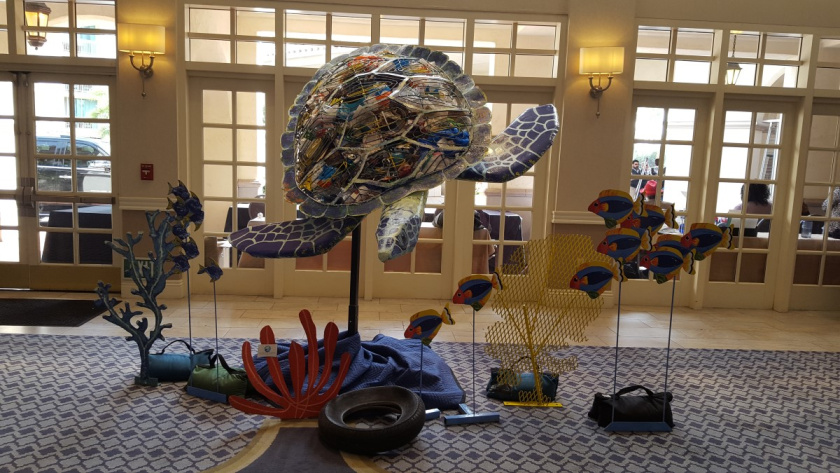
The Washed Ashore project is an inspirational way to educate about plastic pollution. Art can create an emotional response and reaches a wider audience by exposing people to something they would not normally see. Working with marine litter in the visual arts can also create awareness and motivate action to change consumer habits. Marine litter art is oddly fascinating and there was an interesting collection at the conference.
Local to Global Partnerships was another interesting session. At KIMO we recognise the need to partner with other effective organisations and show our support. Each organization has its own strengths and partnerships can draw on complementary strengths to help the marine environment. KIMO has a partnership with the Global Ghost Gear Initiative, who had a visible presence at the conference. GGGI believe that working together strengthens the overall effort. Many joint efforts stress the importance of collecting good data in order to inform policymakers. This continues to be a cornerstone of KIMOs work.
The Marine Debris Alliance keeps a marine debris database similar to OSPAR but on the Pacific west coast. They have focus on information sharing and would like to build a centralized platform to exchange best practices and lessons learned.
Trash-Free Waters Projects (EPA) have some really good research and resources as to how to stop litter from entering waterways. There was an interesting study about reducing land based inputs of litter by observing hotspots of litter and the location of trash bins. There was a direct correlation between more litter where there were less bins. Main conclusions showed where trash was observed (water access points, construction sites, overflowing bins, confusion about recycling). They found that people have about a 20 foot attention span for binning trash. Bins need to be clearly labeled. The more attractive they are, the more they are used. Cigarette receptacles are very important. Proper disposal infrastructure needs to be in place so that bins do not overflow. The results of these projects will be of great interest to municipalities who are looking for ways to reduce and prevent inputs of waste to the oceans.
…people have about a 20 foot attention span for binning trash
A research project from the University of Oldenburg Germany uses wooden drifters to track the geographical extent of litter from German waterways. They have released 47000 drifters. The methodology could be easily replicated with wooden blocks stamped with numbers and a message to contact them with the location found. They have been reported on Danish beaches. It could be interesting to use this method to find out which major river is contributing to the sewage waste we find on our beaches. Please spread the word about this project in your KIMO municipalities and encourage people to report any drifters they may find.
Clean Virginia waterways presented information on their campaign to reduce balloons as marine debris in Virginia, USA. Take a look at their excellent publications for practical tips on how to reduce marine litter.
A study from Brazil (Solid Waste Management in Coastal Cities) highlighted the differences of behavior as a tourist visiting a beach area. They found that tourists produce 68% more solid waste and most do not separate the waste as they do at home. This is due to convenience, lack of awareness and information. Increased municipal initiatives could help to better reduce and manage the solid waste by addressing tourists. Another study found that each dollar of beach cleaning invested avoided 4.4 dollars of lost tourist revenue. These findings which will be of keen interest to all KIMO members.
Clean Sea Life involves the ‘users of the sea’ in an extraordinary effort to clean up the Italian coasts and sea floor. Clubs, schools and associations are invited to ‘adopt’ an area, conduct regular clean-ups and adopt simple habits to prevent further littering of the sea. It is a model very similar to the Green Deal approach being undertaken by KIMO municipalities in the Netherlands and deserves wider dissemination at the municipal level.
 Poster Night
 Poster Night
As I was attending to my poster about KIMO’s work with paraffin pollution, I did not get to circulate around and see the other 200 posters. Again an overwhelming amount of information. The amount of research that is being carried out especially on microplastics has greatly increased since the last IMDC in Hawaii. The level of awareness and citizen involvement has also increased.
Many people went by and glanced at our poster, but with the amount of posters, participants were focused on finding information about their areas of interest. My impression was that paraffin was not a known or recognized problem in North America. This could be a reason for the limited interest. I did talk to some people who were interested who were mostly curious about the pictures of “popcorn” on the beach and found the topic and our work very interesting. Professor Jan Van Franeker was by and told of the paraffin in fulmars he has been studying. There are many types they find. One more reason why we need to campaign hard to stop paraffin pollution.
By every measure, the 6th International Marine Debris Conference was a success. As more data emerges about the scale of the marine litter problem, we are once again reminded of the urgency of our mission. It is heartening though that we do not have to undertake this battle alone – volunteers, NGOs, schools, universities and all levels of government are increasingly working together to stop the pollution of our oceans.
A list of posters and abstracts is available here