


KIMO member, Aberdeenshire council, is leading the fight against ocean plastics by installing an innovative new device in the harbour at Banff in Scotland. The Seabin is a nifty little contraption which collects floating marine debris. It was created by two Australian surfers who were looking for a practical way to reduce ocean plastics.
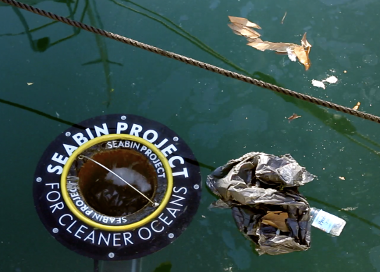
What they came up with is a bin which, when inserted into the calm water of a harbour or marina, begins to work 24/7 to collect marine debris floating on the water’s surface. It is made from recycled plastic and can be powered by renewable energy. Its creators say that in the four years of product testing, no fish were caught in the bin, making it safe for marine life. The fine mesh bag used in the bin is able to remove some microplastics from the water. An improved filtration bag which can even separate out plastic microfibres from seawater is currently being tested. The built-in filter is also able to soak up small oil slicks. Its creators claim that the device is able to catch 1.5 kg of marine debris per day.
While the current incarnation of the Seabin, only works in calm waters, the creators of the device have the long term goal of developing a seabin which could be installed in the floating garbage patches found within the ocean gyres.
The Seabin in Banff is only the second such device to be installed in the UK. Faron McLellan, coordinator for KIMO UK praised Aberdeenshire council’s forward-looking approach saying:
Seabins are a fantastic, low-cost way to help remove marine litter.
The ubiquity of ocean plastics was highlighted last year when researchers from Heriot-Watt University found that levels of microplastics on remote Scottish beaches were as high as those found in industrialised regions. Adding to the already concerning weight of evidence, Greenpeace recently reported that they had found tiny fragments of plastic in nearly two thirds of the water sampled in some of Scotland’s most important feeding grounds for sharks, whales, dolphins and seabirds. Large plastics break down into microplastics so the sooner we remove them from the ocean, the better.
Once the seabin has filled up with litter, this needs to be responsibly disposed of. KIMO UK, who administer the Fishing for Litter scheme that has removed 1,200 tonnes of marine litter from the ocean since 2005, already have a network of dedicated skips for passively fished waste, located across the Fishing for Litter harbour network. KIMO UK’s Faron McLellan, was quick to spot the potential for an environmentally advantageous synergy between the seabins and the Fishing for Litter project:
Once this first seabin has been installed in Banff, we are looking into using our nearby Fishing for Litter skip at Macduff to dispose of the litter. Other harbours have also shown an interest in the Seabin concept.
We hope the Seabin at Banff lives up to its potential and that we will continue to see more innovative solutions such as this to combat the marine litter problem.