


Currently, only 26% of the plastics used in the EU are recycled. The environmental harm caused by our produce-use-discard approach to plastic has become increasingly apparent. Yet, doing away with plastic altogether would place a heavy burden on ecosystems as alternative natural materials would need to be harvested in eye-watering quantities. The most prudent course on a finite planet is the circular economy. By closing the loop on the materials we use, we gain maximum economic benefit with minimal harm to the environment.
However, this requires a rethink of the entire plastics value chain – a complex undertaking which will only be achieved with the cooperation of all the key players. By managing our plastic use better we take a step towards the world envisioned by the UN in its 2030 Agenda for Sustainable Development; a world where consumption and production practices are sustainable, where all unnecessary waste is eliminated, a world where marine litter begins to decline and greenhouse gas emissions decrease.
The marine plastics problem is explicitly mentioned in the Five-Year Bologna Roadmap on resource efficiency, adopted by the G7 Environment Ministers’ Meeting in June 2017 in Bologna:
Assess the economic benefits and opportunities for improved product design and address barriers to recycling and reuse of plastic, in view of reducing the use of primary resources, the negative environmental and economic impacts over its life-cycle and avoid plastics leakage into the environment, in particular the seas and oceans (in coordination with relevant G7 work).
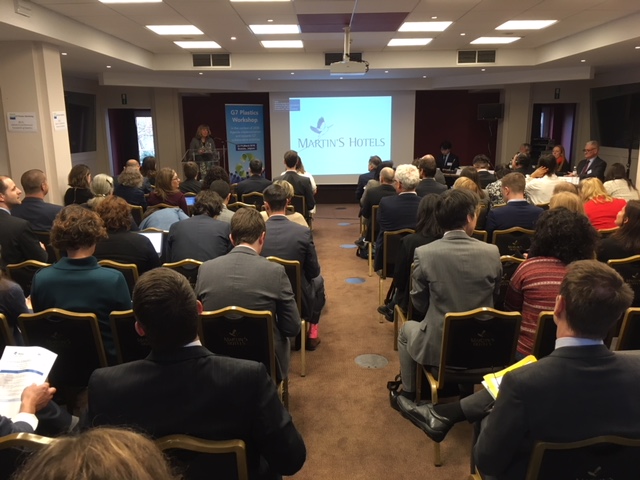
The European Commission’s Plastics Strategy published in January 2018 similarly acknowledges the marine plastics problem and the need for a circular economy. Since the G7 and EC goals are so closely aligned the Ministry of the Environment of Japan and the Environment Directorate-General of the European Commission organised a joint Plastics Workshop in Brussels in March 2018 to share best practice with regards to plastics management. The workshop brought together experts from around the world to explore themes such as:
- Promoting clean plastic value chains
- Collection and recycling systems for plastic waste streams
- Promotion and upgrade of recycled plastic materials
- Addressing single use plastics and microplastics
- Reducing leakage of plastic waste from all sources to water-courses and oceans
The workshop focused on projects that both engage civil society and have a real impact. KIMO was honoured to receive an invite to talk about the Fishing for Litter project and the Green Deal approach which has been so successful in the Netherlands. Fishing for Litter engages harbour-masters, waste-operatives and fishermen in a mutually beneficial network that has removed thousands of tonnes of marine litter from the seas around Europe. The project started in a single port and has since expanded to more than 60 ports in 8 countries. The Green Deal Fisheries for a Clean Sea aims to integrate waste handling in the fisheries sector by preventing waste from the industry, properly managing waste on board ships and in harbours and recycling industry related waste wherever possible. The Green Deal for Clean Beaches brings together NGOs, municipalities, beach-side business owners and the public to actively work together at keeping their beaches clean. There are currently 8 ‘My Beach’ locations in the Netherlands where local stakeholders are encouraged to ‘adopt a beach’ as it were – taking that extra bit of responsibility for maintaining the cleanliness of their local beach. Owners of pavilions (a form of ‘beach cafe’) are also being taught how to conduct beach cleanliness monitoring in future.
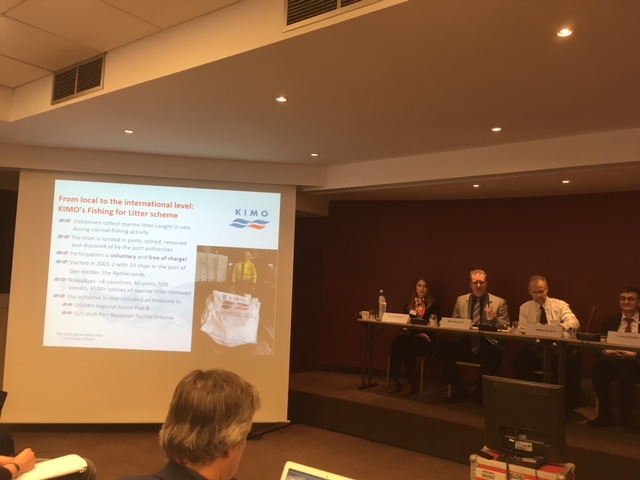
KIMO’s presentations were well received, generating a lot of interest during the panel discussion. Many thanks to Mike Mannaart, Executive Secretary of KIMO Netherlands and Belgium, for a job well done. As KIMO networks with other organisations, governmental and intergovernmental bodies, the same message keep emerging: looking after our seas requires a group effort by everyone who cares about them (‘stakeholders’ is such a bland word). Fortunately there are a lot of people who do care – we just need to bring them together.