
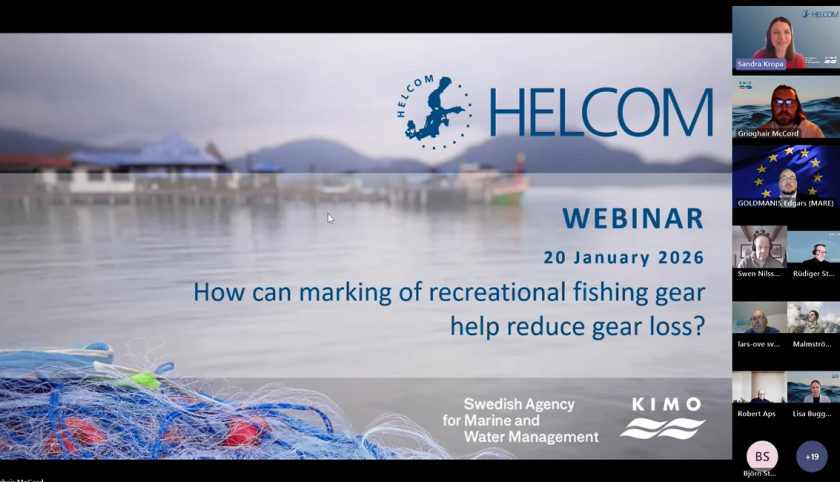
KIMO is pleased to announce the successful conclusion of the webinar, “How can marking of recreational fishing gear help reduce gear loss?”, which brought together participants from policy, science, industry, and recreational fishing communities across the Baltic Sea region and beyond. The webinar which took place on the 20th of January 2026 was hosted by the Baltic Marine Environment Protection Commission (HELCOM) and organised by KIMO with generous funding provided by the Swedish Agency for Marine and Water Management (SwAM).
The webinar addressed a critical environmental challenge: abandoned, lost, or otherwise discarded fishing gear (ALDFG), a significant source of plastic pollution and a threat to marine life in our seas. As highlighted on the HELCOM event page, lost recreational fishing gear—including nets, lines, and traps—contributes substantially to marine litter, causing ghost fishing, damaging habitats, and breaking down into microplastics.
The discussions provided a timely and comprehensive overview of the global and regional drive towards systematic gear marking of recreational fishing gear as a primary tool for prevention and accountability. The event comes at a crucial juncture, with the new EU Implementing Regulation (EU) 2025/274 on marking recreational passive gear coming into force January this year.
Global Momentum and EU Policy: The Framework for Action
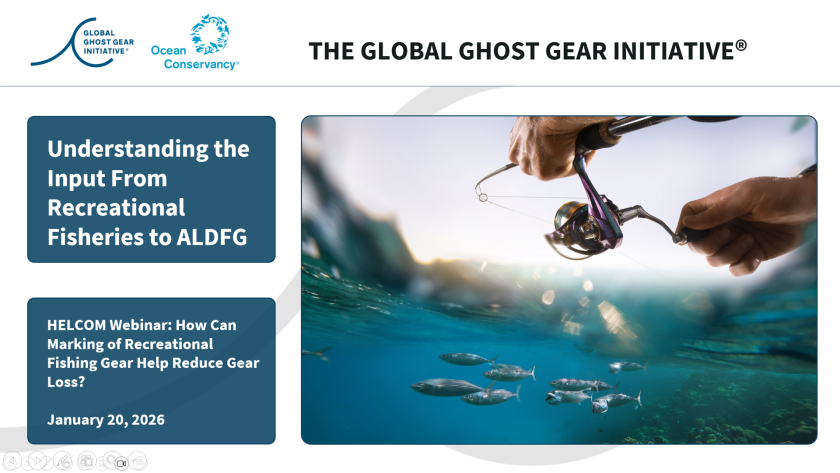
The webinar opened with a keynote address from Joel Baziuk, Associate Director of the Global Ghost Gear Initiative (GGGI), setting the stage by framing the global scale of the ALDFG crisis. The GGGI underscored that lost fishing gear is a persistent form of plastic pollution and the most deadly form of marine debris for wildlife, creating a clear and urgent imperative for preventative measures like gear marking.
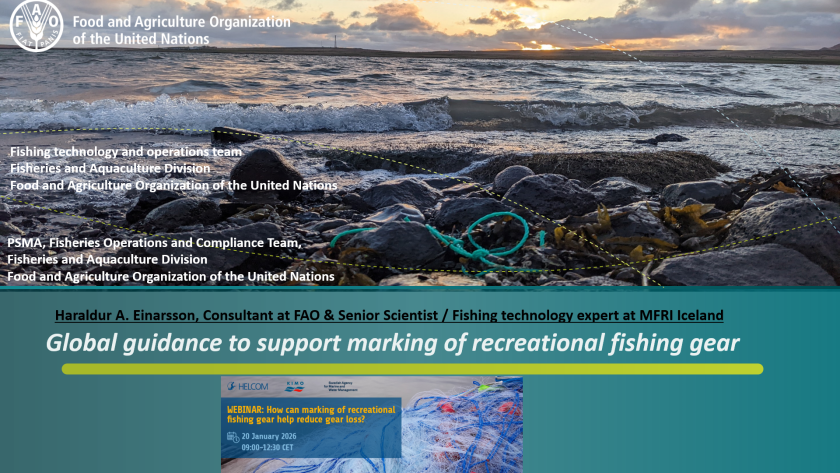
Following this, the focus shifted to the concrete frameworks enabling action. Haraldur Arnar Einarsson, Fishing Gear Expert from the UN Food and Agriculture Organization (FAO) detailed the timeline for mandatory gear marking, which is expected to come into force globally by the end of the decade following a planned amendment to the MARPOL Annex V. The FAO’s Voluntary Guidelines on the Marking of Fishing Gear (VGMFG), supported by practical manuals and risk assessment frameworks, were highlighted as the cornerstone for global efforts, supporting traceability, environmental protection, safety, and the fight against Illegal, Unreported, and Unregulated (IUU) fishing.
The focus then shifted to the European Union, where a significant policy shift is underway. Edgars Goldmanis of the European Commission’s DG MARE presented the revised EU Control Regulation, which extends gear marking rules to recreational fisheries. The key driver is stark: fishing-related litter constitutes 27% of marine litter in the EU, with an estimated 11,000 tons of fishing gear lost annually.
The resulting Commission Implementing Regulation (EU) 2025/274 is now active. It mandates the mandatory marking of passive recreational fishing gear (excluding hand-held gear) with owner/user identification. The regulation is technology-neutral, allowing for various marking methods, but requires that marks be durable, securely fixed, visible on the water surface, and enable the gear to be linked to its user.
On the Ground: National Implementation, Challenges, and Insights
The heart of the webinar lay in national case studies, revealing both progress and persistent hurdles.
- Sweden (Per-Olof V Andersson, Swedish Agency for Marine and Water Management): Sweden highlighted the complexity of implementing the EU rules within its existing legal framework, where fishing is a public right. Key questions were raised regarding the practical application of the new EU rules, such as marking requirements for linked nets and the placement of labels on large stationary traps. Sweden is considering aligning recreational gear marking rules with those for commercial fisheries for consistency.
- Estonia (Anu Albert & Robert Aps, Estonian Marine Institute): Estonia showcased a well-established system. Regulations require high-visibility marking (e.g., specific flag configurations for nets, buoy size for pots) and clear identification linking gear to the fisher’s permit number. While compliance is high and voluntary reporting exists, challenges include growing recreational gillnet use and the need for mandatory loss reporting to improve prevention.
- Denmark (Arne Rusbjerg, Danish Recreational Fishing Association): Presenting the fishers’ perspective, the Danish case offered a candid assessment. While new rules mandate the reporting of lost gear, a major concern was raised: mapping projects in areas like the Limfjord found that a large proportion of recovered lost gear was unmarked, indicating use in illegal fishing. This underscores a critical challenge: new rules primarily affect compliant fishers, and their success is contingent on adequate enforcement resources to deter illegal activity.
- Iceland (Haraldur Arnar Einarsson, Fishing Gear Expert from the FAO): Iceland has had regulations requiring the gillnet gear marking (on the floats and anchors) for decades but there was no requirement to mark the net itself. The government implemented regulations in 2020 which required the marking of all fishing gear (both commercial and recreational). The fishermen struggled initially to mark their nets as marking equipment was not supplied by gear manufacturers. As a solution they started to mark their gear with livestock tags. Working with suppliers to facilitate easy gear marking would help with more effective implementation of gear marking regulations. Clear guidelines on how to report on lost gear are, however, still lacking in Iceland.
The Road Ahead
The concluding consensus was clear:
- Gear marking is a vital, cost-effective prevention tool that fosters accountability, supports recovery, and reduces abandonment.
- Collaboration is non-negotiable. Successful implementation depends on seamless cooperation between authorities, fishers, NGOs, and scientists.
- Marking is part of a broader solution. It must be integrated with education, improved gear disposal/recycling systems, and spatial/temporal management of high-risk activities.
- The time for action is now. With the EU rules in force and global standards advancing, 2026 marks a key operational phase for turning policy into tangible protection for marine ecosystems like the Baltic Sea.
KIMO’s Role and a Call to Continued Collaboration
KIMO was honoured to facilitate this essential dialogue on behalf of HELCOM. As a network of local governments working for clean seas, KIMO recognises that tackling marine litter requires action at all levels—from international policy to local enforcement and community engagement. The Baltic Sea, a sensitive and valuable semi-enclosed ecosystem, is a prime example of where regional cooperation, as championed by HELCOM, is vital.
The webinar underscored that marking fishing gear is more than a bureaucratic requirement; it is a practical step towards cleaner seas, greater fisher accountability, and healthier marine ecosystems.
KIMO extends its gratitude to all speakers, participants, HELCOM, and funder SwAM for making this event a success. The conversations today mark not an end, but a strengthening of the ongoing regional commitment to turn policy into positive action.
For more details on the webinar, including the full context and objectives as outlined by HELCOM, please visit the event page: https://helcom.fi/helcom-at-work/events/events-2026/webinar-how-can-marking-of-recreational-fishing-gear-help-reduce-gear-loss/
You can also view the video recording of the webinar on HELCOM’s YouTube channel:
About KIMO International:
KIMO International is a network of municipalities working together for clean, healthy seas. We bring together municipalities, ports, fishers and other stakeholders to find practical solutions to marine pollution, protect coastal communities, and promote sustainable practices.
About HELCOM:
The Baltic Marine Environment Protection Commission, also known as the Helsinki Commission (HELCOM), is an intergovernmental organisation and the governing body of the Convention on the Protection of the Marine Environment of the Baltic Sea Area (Helsinki Convention). HELCOM works to protect the marine environment of the Baltic Sea from all sources of pollution, ensure the restoration of its ecological balance, and promote sustainable use of its marine resources. The Commission brings together the nine Baltic Sea coastal states and the European Union to make decisions and take collective action.
About the Swedish Agency for Marine and Water Management (SwAM):
The Swedish Agency for Marine and Water Management (SwAM – *Havs- och vattenmyndigheten*) is the government agency responsible for integrated marine and water management in Sweden. Its mission is to ensure sustainable use and management of seas, lakes, and rivers to achieve good environmental status. SwAM develops knowledge, provides advice, and coordinates national efforts to protect aquatic ecosystems, including combating marine litter, promoting sustainable fisheries, and implementing national and EU environmental legislation.