


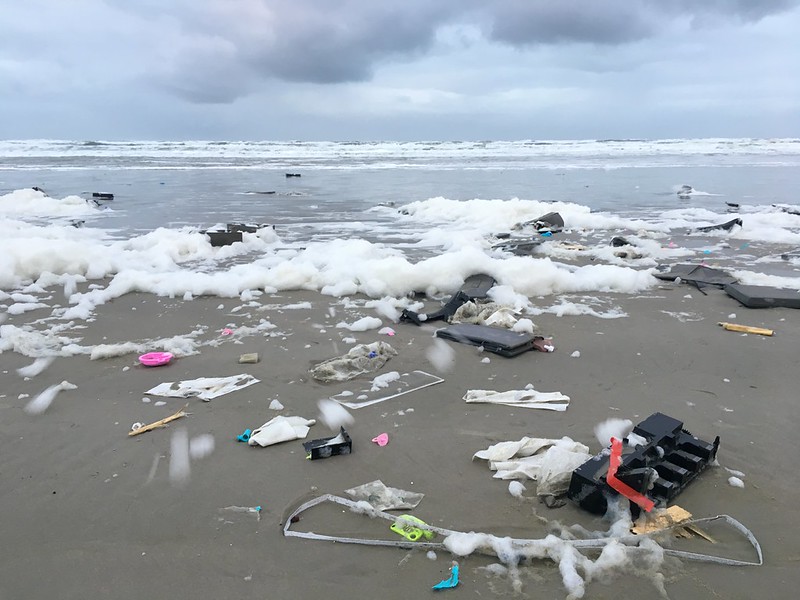
Recent incidents of shipping containers lost overboard in the English Channel have reignited urgent concerns about marine pollution and the lack of accountability in the maritime industry. Communities along the English coast are once again facing the environmental and economic fallout, highlighting the persistent failure of current systems to protect our seas.
Incidents Highlight Systemic Issues
Authorities are investigating after several containers were lost from a cargo vessel in the English Channel earlier this month. The incident, which led to debris washing ashore in Kent and East Sussex, is under scrutiny with a focus on cargo securing practices. This follows another disruptive event in December 2025, where containers carrying frozen onions and fries spilled their contents across a beach in East Yorkshire, requiring a large-scale clean-up operation.
These are not isolated events. Over the past 20 years, single incidents have seen between 99 and over 1,800 containers lost at sea, often due to severe weather, but also because of human error such as improper stacking, overloading, or inadequate securing.
The Hidden and Lasting Damage
While visible debris on beaches captures headlines, a more insidious problem lies beneath the waves. Lost cargo that sinks to the seafloor creates long-term pollution hotspots. Clean-up at depth is complex, exorbitantly expensive, and often falls to volunteers or underfunded public authorities. The lack of clear EU standards defining a “clean” seafloor and mechanisms to measure progress leaves a legal and environmental vacuum.
“The current situation is unacceptable,” says Lisa Bugge Nør Larsen, Executive Secretary of KIMO International. “Coastal communities, who did not create this problem, are repeatedly left with the bill and the mess. Litter is left for years on our coastlines and seabed, in stark contrast to how we maintain our land environment. This contradicts the fundamental ‘polluter pays’ principle.”
KIMO’s 2025 Resolution: A Blueprint for Change
In response to this ongoing crisis, KIMO’s General Assembly in 2025 passed an updated resolution, Tackling Pollution from Lost Containers – a Responsible and Fair Approach. The resolution outlines a clear path forward:
- Enshrining “Polluter Pays”: KIMO urges national governments and the EU to influence the International Maritime Organization (IMO) to adopt a binding convention ensuring shipping companies fully compensate governments for clean-up costs.
- Mandating Clean-Up: The European Commission is called upon to implement a directive requiring EU member states to clean up lost cargo at sea.
- Creating a Rapid Response Fund: KIMO advocates for a dedicated European fund to provide immediate financial support to national and local governments facing pollution incidents, enabling swift action.
- Setting Seabed Standards: There is a critical need to establish environmental liability and clear standards for seabed cleanliness after an incident.
A Legacy of Advocacy
KIMO has been a leading voice on this issue for decades, first raising the lack of robust compensation regimes at the 4th North Sea Ministerial Conference in 1995. The 2019 MSC Zoe disaster, which left 800,000 kg of debris in the North Sea largely uncollected due to funding shortfalls, remains a tragic example of the system’s failure.
“The time for assurances is over. The time for action is now,” says KIMO President, Preben Friis-Hauge. “Our 2025 resolution provides the framework. We need governments and the EU to show political will, hold the industry accountable, and finally ensure our coastal communities and marine ecosystems are no longer forced to bear the cost of maritime negligence.”
KIMO’s members are submitting this resolution to all national governments, the European Commission, the IMO, and regional sea conventions like OSPAR and HELCOM.
—
About KIMO International:
KIMO is an international network of local authorities working to protect and preserve coastal waters from pollution and environmental degradation. We advocate for sustainable marine policies and empower communities to safeguard their marine environment.
Links to Incident Reports:
gCaptain Article on UK Probe into Cargo Securing
BBC News: December 2025 Container Spill