


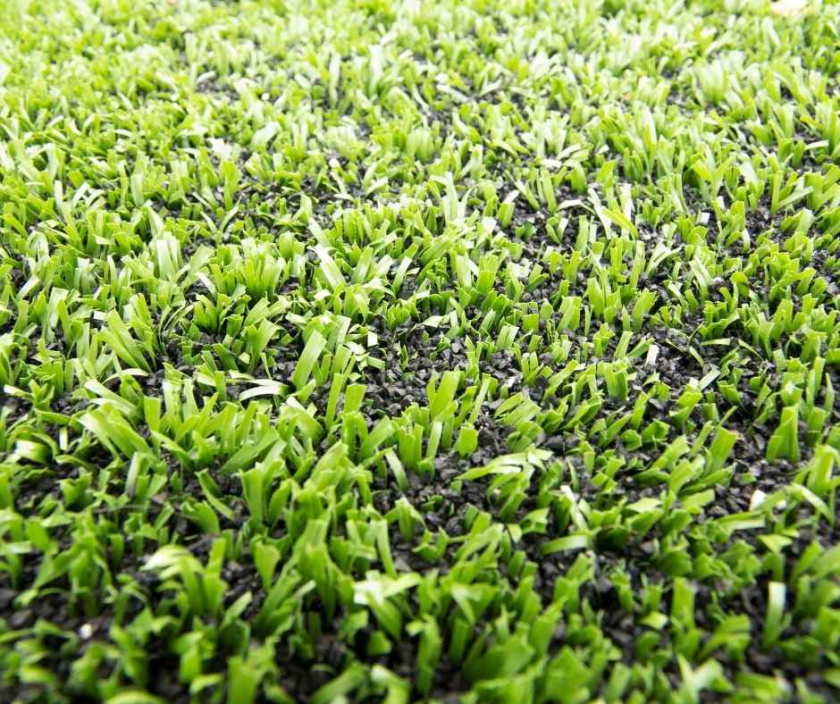
Today KIMO Sweden releases their much awaited report investigating the problem of microplastic pollution from artificial turf playing fields. Each year KIMO Sweden present a scholarship to investigate a pressing environmental problem. This year’s scholarship holder, Emma Brodén, focused her research on artificial turf.
Artificial turf is popular in Sweden which has around 1300 synthetic turf pitches and many new ones are built each year. Compared to natural grass turf, artificial turf allows for more intensive use and a longer playing season. In artificial turf pitches there are small pellets called granules. They lie loose in the artificial grass to provide softness and the desired characteristics to the turf. The granules are most often made of synthetic rubber or plastic, and their small size qualifies them to be classified as microplastics. The granules are spread from the turf to the natural environment where they can cause environmental harm.
The new report was written to assess the magnitude of the granule emission problem in Sweden, and to investigate the effect of the granules in the sea. Furthermore, the aim is to investigate how the emissions can be decreased and avoided through different protective measures, and to map different alternatives to plastic granules. Information has been gathered from scientific papers, reports, and other written sources, but also through a survey and interviews with Swedish municipalities and public agencies.
The results show that artificial turf pitches are a significant source of microplastics. In Sweden, an artificial turf pitch is expected to emit around 550 kg of granules per year. Since there are around 1300 artificial turf pitches in Sweden, this equates to total emissions of around 700 tons per year. Artificial turf pitches are the second biggest land-based source of microplastics in Sweden (following tyre particles from road traffic). Given this fact, artificial turf is a source of microplastic pollution that is highly relevant to address.
How much of the emitted granules reach the sea is unknown, but the granules have been shown to have negative effects on marine organisms. A big part of the granules’ negative impact is caused by environmentally harmful substances that the granules contain. Various protective measures can be taken to decrease the emissions of granules from artificial turf. Since most emissions are maintenance related (especially snow management can cause significant granule migration), different protective measures connected to maintenance are important. These changes in routines should be combined with physical installations such as frames around the turf and special areas dedicated to snow storage. To avoid emissions to the sea, it is important to install granule filters in stormwater drainage wells and also to situate the artificial turf pitches at a safe distance from water. The maintenance and protective measures taken vary greatly between different turf pitches and municipalities.
For protective measures to be implemented on more pitches, the report recommends that municipalities conduct more thorough environmental inspections, and that more demands are made on the managers accountable for the maintenance of the pitches. While protective measures can decrease emissions, they cannot eliminate the problem of granule pollution. Today, alternatives to artificial turf are being tested. Granules made from natural materials and degradable plastics, as well as granule-free turfs, are currently being assessed by several Swedish municipalities.
An EU ban on plastic and rubber granules, which is currently discussed in the EU commission, could give the right incentives to find materials with a better play performance. It is also plausible to assume that future turf solutions will vary depending on where they are used. The report is concluded with a list of measures that different stakeholders can implement to reduce the emissions of environmentally harmful granules.
The full report is available in Swedish and can be downloaded below.