


Today KIMO Sweden releases a report investigating the problem of PFAS. Each year KIMO Sweden offers an internship to investigate a pressing environmental problem. This year’s intern, Milou Grylls, focused her research on PFAS in the marine environment, as well as on the management of the problem in municipal operations.
Per- and polyfluorinated alkyl substances (PFAS) are a group of man-made substances that have been widely used in various industries since the 1950s. They are stable, difficult to degrade and grease- and water-repellent, which has contributed to their use in everything from electronics to clothing and firefighting foam.
Their properties make them mobile, which has contributed to large-scale spread in the environment. The spread has ecological and economic consequences and poses a threat to humans and animals due to the negative health effects of the substances. Since the substances have many uses, there are a large number of sources of PFAS in the environment and in Sweden the main source has been the use of firefighting foam.
Runoff from treatment plants and landfills has been identified as significant pathways. The deep sea has been described as the only PFAS sink, but new research suggests that sea spray aerosols can return PFAS to the terrestrial environment and that this enables a continuous cycle of PFAS.
The issue of PFAS is complex and highly topical, as it affects many societal actors. Cooperation is needed to prevent and manage existing pollution. Municipalities have an important responsibility as well as opportunities to act to minimise and remedy it.
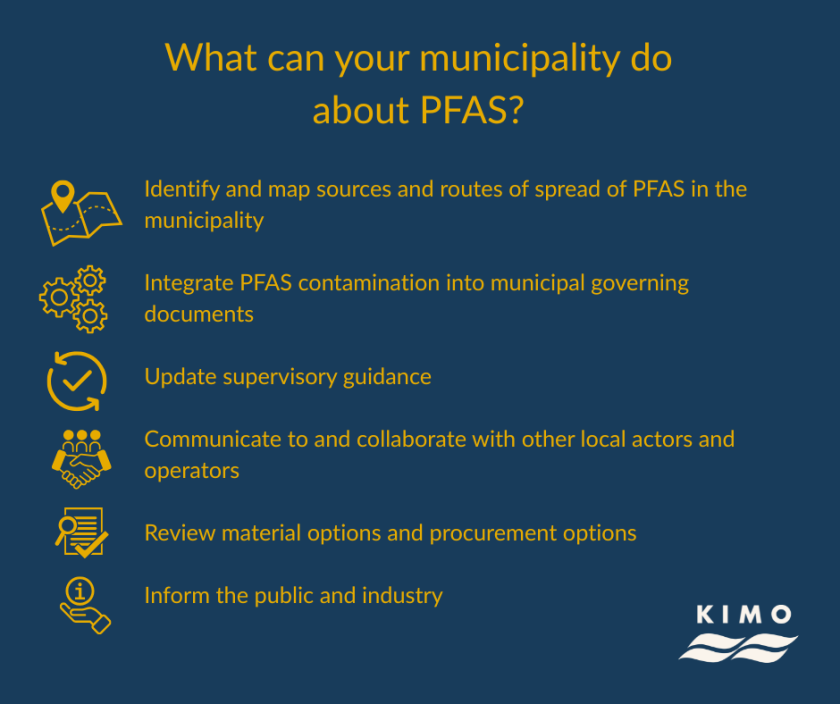
KIMO Sweden’s report has a special focus on PFAS in the marine environment, as well as on the management of the problem in municipal operations. It includes background knowledge about PFAS and information on how municipalities can work to minimise their use and spread. The current state of the regulatory landscape is described, and bolstered with good examples of current efforts to combat PFAS being made by municipalities in Sweden and beyond.
Of particular interest to those in local government, are the many avenues of intervention available to municipalities for engagement with the problem of PFAS. While waiting for stricter legislation and the phasing out of PFAS, the work of municipalities will be an important part of protecting people and the environment.
The report is important reading and strengthens the knowledge for municipalities to continue their work for healthy and vibrant marine environments.
Download the full version of the report below.