


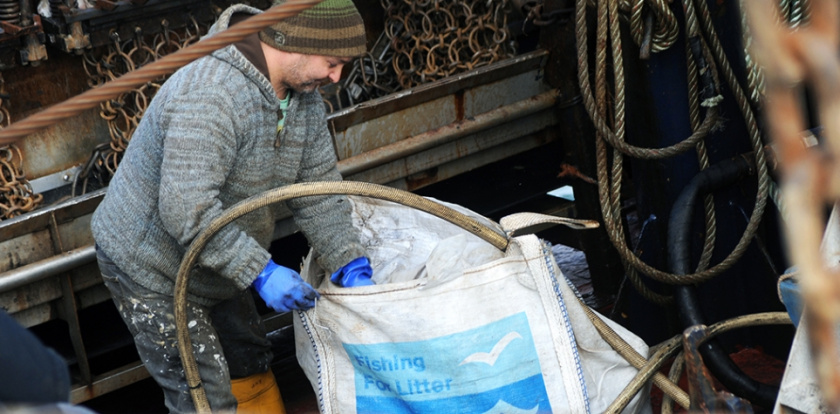
One of KIMO’s most successful projects is Fishing for Litter. Conceived by KIMO in 2001, Fishing for Litter has established itself as the leading scheme for fishers to remove marine litter from the sea. As well as the physical removal of marine litter, the scheme provides a valuable means of education and awareness raising within the fishing industry of the problems caused by marine litter. Additionally, it gives participating fishers a sense of ownership and of making a personal and tangible contribution to the reduction of marine litter in the oceans.
The Fishing for Litter project has now expanded across Europe and is administered by an array of organisations ranging from national governments to small NGOs.
Revision of the Port Reception Facilities Directive
In January 2018 the European Commission published its proposal for the revision of EU Directive 2000/59/EC on Port Reception Facilities. Under the International Convention for the Prevention of Pollution from ships (the 73/78 MARPOL Convention), the discharging of all forms of plastics into the sea is banned but it remains the case that a proportion of marine litter in EU seas comes from ships and fishing vessels. The main objective of the revision is to reduce discharges of waste from ships into the marine environment through a combination of economic incentives, enforcement and exemptions.
One of the key elements of the revised Directive is the introduction of a framework for fee systems through which Member States are required to ensure that the costs of port reception facilities for ship-generated waste, including the treatment and disposal of the waste, are covered through the collection of a fee from ships. Key to the fee framework is that it should provide no incentive for ships to discharge their waste into the sea.
What is the issue?
As the revised PRF directive (DIRECTIVE (EU) 2019/883) is transcribed into national law, it is becoming clear that EU member states have very different interpretations as to the requirements of the directive, especially with regards to passively fished waste. It is KIMO’s opinion that some of these interpretations run directly counter to the requirements of the directive and through disincentivising policies risk increasing marine litter in European waters in direct contradiction to the stated aims of the directive.
If the Directive is to achieve its stated goal of reducing marine litter and improving the health of European waters, KIMO proposes that the following principles should be adhered to by each member country when the directive is implemented at national level:
- No increase in the indirect fee paid by fishers in order to cover the disposal costs of passively fished waste
- Existing Fishing for Litter schemes should continue to be funded and expanded
- Wherever possible new Fishing for Litter schemes should be implemented
- Passively fished waste should be treated as a separate waste stream: volume and quantity should be recorded and monitored
- The establishment of alternative cost recovery systems to cover 100% of the handling and disposal costs for passively fished waste is absolutely essential
What’s happening in Norway?
The Fishing for Litter scheme in Norway is funded by the national Government through the Norwegian Environmental Agency`s funding scheme for measures against marine litter. It is administered by Norwegian NGO, SALT.
At present the revised PRF is being implemented in Norway. In December 2020 the Norwegian Environment Agency and the Norwegian Maritime Directorate sent a joint recommendation to the Ministry of Climate and Environment that proposes some amendments to the Pollution Control Regulations, with a view to facilitating more reuse and recycling of waste. The detail of the proposal is to phase out the Fishing for Litter scheme in Norway and instead to increase the indirect fee on fishing vessels. Norwegian fishing vessels will be subject to an annual fee increase of 1000-1400 NOK. They argue that since the current scheme is expensive to administer and only operates in eleven Norwegian ports, a large increase in funding would be required to scale the Fishing for Litter scheme to all fishing ports.
To dismantle an existing Fishing for Litter scheme and simultaneously increase the indirect fee in order to recoup costs for passively fished waste runs directly counter to the spirit and letter of the revised PRF directive. Not only does such a policy risk disincentivising fishers from collecting and landing passively fished waste, it also fails to take into account the important behavioural changes that Fishing for Litter promotes in fishers and thus is likely to decrease the amount of passively fished waste being landed and also increase the amount of littering at sea.
What has KIMO done about it?
KIMO submitted a position statement to the Norwegian Environment Agency during their public consultation urging them to:
- Continue funding the Fishing for Litter project in Norway
- Expand the project to all Norwegian fishing ports
- Explore alternative supplementary financing mechanisms for the Fishing for Litter project in Norway to make the continuation and expansion of Fishing for Litter in Norway possible
The full text of the position statement can be downloaded below