


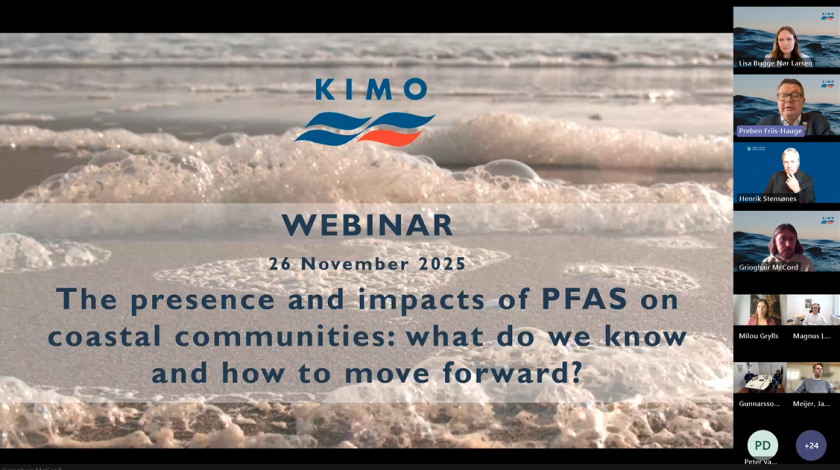
On Wednesday, 26th November 2025, KIMO hosted a webinar, “The presence and impacts of PFAS on coastal communities: what do we know and how to move forward?”. The event brought together experts and policymakers to dissect the alarming spread of PFAS (Per- and polyfluoroalkyl substances) in our marine environment and its subsequent impact on coastal areas.
The webinar was a resounding success, providing critical insights into the scale of the problem and, importantly, launching a new practical guide to help municipalities take action.
A Widespread Problem in European Waters
The session opened with a stark overview from Magnus Løfstedt of the European Environment Agency (EEA). He presented data from the EEA’s recent briefing, revealing that PFOS—a legacy PFAS compound—is widespread in European waters. The data showed a high percentage of regulatory threshold exceedances, with 47% to 100% of monitored transitional and coastal waters failing to meet the annual average environmental quality standard between 2018 and 2022.
Mr. Løfstedt emphasised that current monitoring is insufficient, covering only a limited number of PFAS compounds and geographical areas. He concluded that this widespread presence seriously challenges the EU’s Zero Pollution ambition and the goal of achieving good chemical status for Europe’s water bodies.
From Sea to Land: An Unexpected Pathway
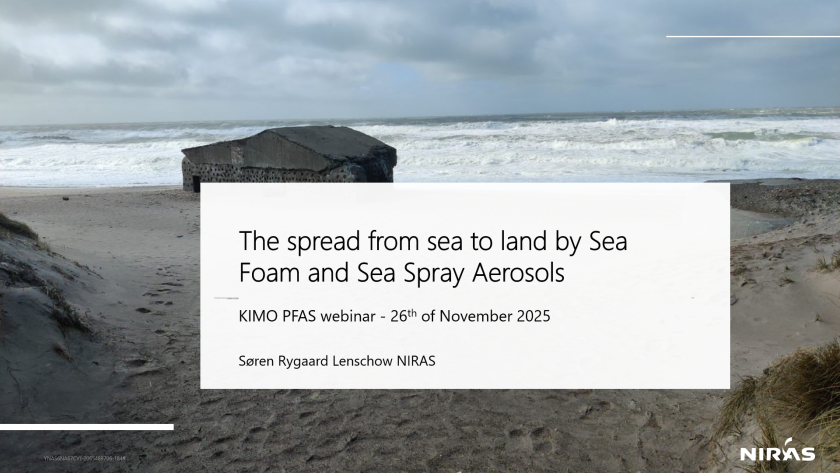
Søren Rygaard Lenschow from NIRAS then presented compelling evidence from Denmark of a previously underestimated pathway: the transport of PFAS from the sea back to land via sea foam and sea spray aerosols.
His investigation on the west coast of Jutland found PFAS contamination in groundwater, drainage water, and drinking water wells, with concentrations decreasing the further inland you go. The source was traced to the ocean itself. Analysis of sea foam collected after a storm revealed astronomically high PFAS concentrations of 120,000 ng/l—60,000 times the Danish drinking water criteria.
Mr. Lenschow explained that PFAS, being surfactants, enrich at the air-water interface. Wave action creates bubbles and aerosols that are heavily laden with these chemicals, which are then blown inland by the wind, depositing onto land and infiltrating groundwater. This mechanism has led to contamination of coastal meadows, posing a risk to grazing livestock and wildlife.
The Science Behind the Sea Spray Cycle
Bo Sha, a postdoctoral researcher from Stockholm University, delved deeper into the science, explaining how the ocean acts as a major global reservoir for historical PFAA emissions. His research demonstrated that PFAS are dramatically enriched in the sea surface microlayer and can be re-emitted into the atmosphere through sea spray aerosol (SSA) production.
Dr. Sha revealed that for some legacy PFAS like PFOA and PFOS, the re-emission via sea spray is now greater than all other direct emissions to air combined. A significant portion of this emission comes from coastal waters, and a substantial percentage deposits back onto coastal land. He highlighted that estimated concentrations of PFAS in rainwater in Denmark are worryingly close to the national drinking water guideline, confirming this as a significant and ongoing source of contamination for coastal communities.
A Call to Action for Municipalities
The webinar then turned to solutions. Milou Grylls, presenting her work for KIMO, outlined the crucial role local authorities play in tackling PFAS pollution. She highlighted municipal areas of control such as supervision, spatial planning, procurement, and water management as key levers for change.
She shared inspiring examples from municipalities across Europe:
* Kungälv, Sweden: Investigating PFAS in a drinking water source located near the coast.
* Lemvig, Denmark: Uncovering sea foam as the source of widespread local contamination.
* Veere, Netherlands: Mapping PFAS in coastal soils and engaging with concerned farmers and residents.
Launch of KIMO’s New Municipal Policy Guidance
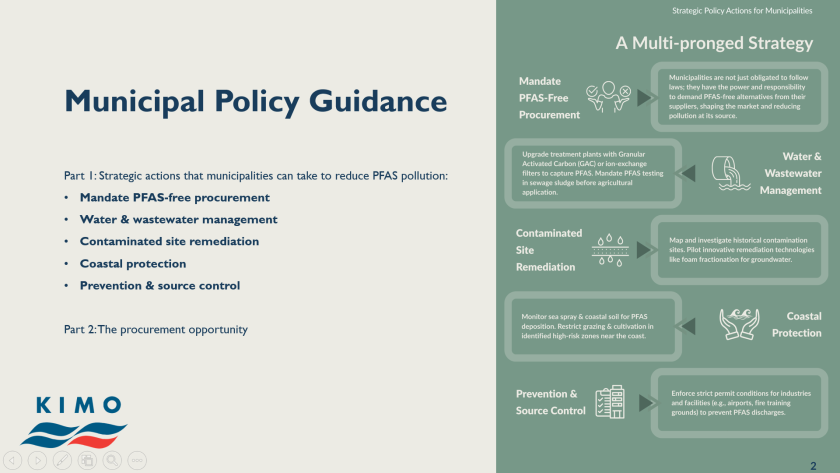
A key outcome of the webinar was the launch of KIMO’s new policy document, ‘Combating PFAS Pollution – Municipal Policy Guidance’. This practical guide outlines a multi-pronged strategy for municipalities, with a special focus on the powerful tool of PFAS-free procurement. The guidance provides a clear implementation framework, advising municipalities to establish PFAS task forces, train procurement officers, and join collective agreements to drive the market towards safer alternatives.
Charting the Way Forward
The webinar concluded with an interactive session, where participants provided valuable feedback to help prioritise the most urgent questions that need answering to fully understand the burden faced by coastal communities. This input will be instrumental in shaping KIMO’s future advocacy and research efforts.
The overwhelming takeaway from the webinar is that PFAS pollution is a long-term challenge for coastal areas. While regulatory measures will take time to show effect, local authorities are not powerless. Through informed policy, strategic procurement, and cross-border collaboration, municipalities can take decisive steps today to protect their communities and environment from the enduring threat of PFAS.
Download the webinar recording or for more detailed information please download the KIMO documents below: