


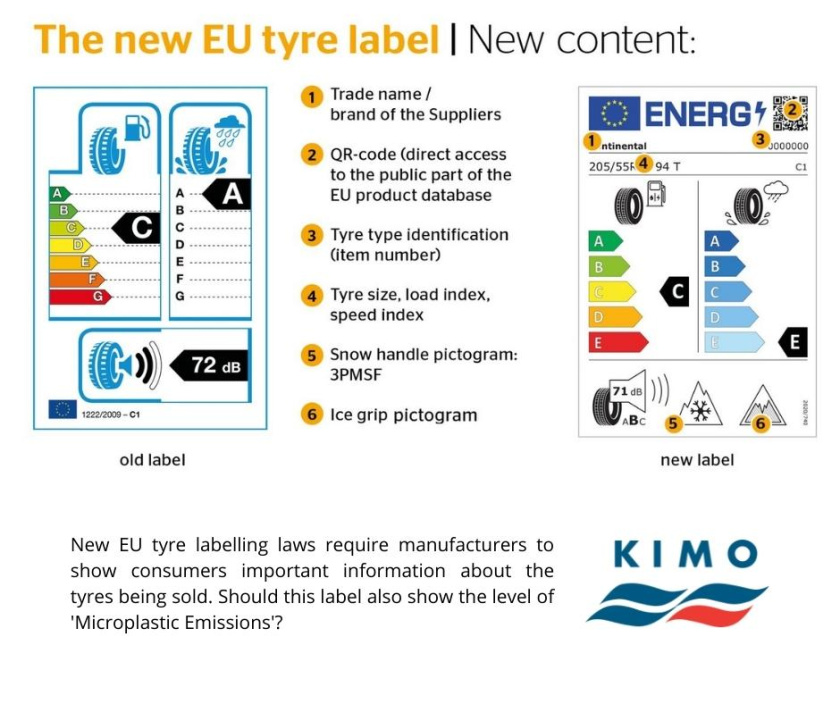
On 1st of May 2021, EU Regulation 2020/740 entered into force. The purpose of the new rules is to give consumers more transparency in the market and a greater basis for comparison when choosing tyres for their vehicle. This means, among other things, that tyre suppliers are obliged to report data on all their tyres to the EU Product Database. According to the new regulation, tyre distributors must ensure that all technical advertising material relating to the specific type of tyre is shown with a specific tyre label. The new tyre label must help ensure that consumers can choose a safe and environmentally friendly solution when buying tyres.
All tyres sold in the EU must be marked with tyre codes. The new EU tyre label provides objective, reliable and comparable information on three important tyre characteristics: rolling noise – and thus fuel efficiency – wet grip and external rolling noise. There are also pictograms that describe the tyre’s snow grip (3 PMSF symbol) and / or grip on ice-covered roads, although the latter only applies to passenger cars.
However, the new rules will not cover the rate at which tyres shed particles – a major contributor to microplastics in Europe. Evidence is mounting that microplastics from tyre abrasion is a real problem. The EU is aware of this and wants to include this in the labelling regulations. However, this has not happened because there is no agreed method for the calculation of abrasion. However, environmentalists are sceptical and suggest the tyre industry is using this excuse as a delay tactic, as for tyre makers facing new rules, the stakes are high. EU lawmakers are considering regulations that would set minimum standards for tyre design to reduce microplastic pollution, such as the rate of abrasion and durability. The requirement could lead to billions of dollars in redesign costs for tyre makers.
But the evidence is strong, with the total of microplastics generated from the wear of automotive tyres in the EU being 503,586 tonnes per year, constituting one of the largest sources of microplastics in the aquatic environment.
According to multiple studies tyres are one of the main culprits for microplastic pollution. Abrasion of tyres and road paints produce microplastic particles, which enter rivers and lakes from road run-off and can eventually be deposited into the sea. Microplastics have well-documented impacts on marine wildlife and the food chain, and studies estimate that emissions from tyre wear particles make up approximately 5 -10% of all microplastics entering the marine environment.
Most people believe tyres are made of rubber, but in reality they consist of mostly plastics. Contrary to public perception, today tyres are a combination of natural (19%) and synthetic rubber (24%) with fillers, softeners, vulcanization agents and other additives mixed to improve the quality. This makes tyres more flexible, improving wet grip performance and increasing their longevity. While driving, the friction created between the road and the tyres generates microplastic wear particles that are directly released to the surrounding environment.
In 2018, an estimated 237 million passenger cars were recorded on European roads and consequently, vehicles tyre wear particles because of breaking and accelerating are now considered to be one of the most dominant forms of microplastic pollution.
Evidently, this shows that we need a reliable, accurate and reproducible method to test and measure tyre abrasion and mileage. Tyres are a major source of unintentional microplastic emission and it is time to do something about it. EU decision makers need to kickstart concrete action to mitigate these effects by including abrasion as a parameter on the tyre label. ISO and ASTM already have international test methods to determine the amount of tyre wear shed during use and these can be used for the development of a European method to measure abrasion.