


If media campaigns are the Lamborghinis of the marine conservation world, political lobbying might best be described as a rusty pickup truck. Lobbying work is often a slow, long, hard slog that happens behind the scenes. Writing research papers, submitting them to the relevant committee meeting of this or that international institution, getting a response and repeating the whole process year in and year out until eventually a small change is made to a policy or legal framework. It’s not glamorous but in the long run, it gets results with far-reaching consequences.
 Much of KIMO’s lobbying work happens beneath the public radar and even many of our supporters might not be aware of much we’re doing behind the scenes to fight the pollution of our seas and coastlines. ‘KIMO submits a paper on paraffin strandings to OSPAR’ is hardly a show-stopping news headline. However, with the current levels of high interest around the scale of ocean plastic pollution, we thought that news of our recent round of letters urging governments and intergovernmental bodies to take action on microplastics might be of interest to our readers.
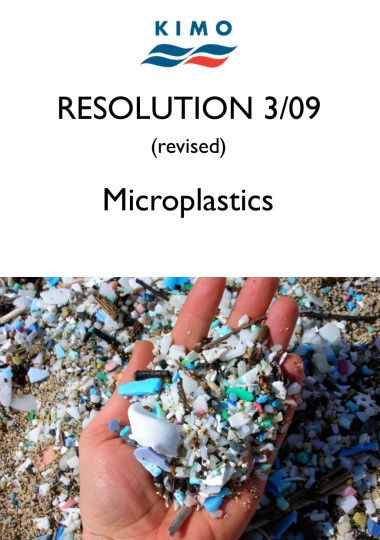
KIMO believes that it is essential to establish the full human health and environmental impacts of microplastic pollution entering the ocean and in line with the precautionary principle to reduce inputs of plastics and microplastics to the marine environment. At its AGM in 2016 KIMO passed a Resolution calling on all European governments to take concrete steps to address the issue of microplastic pollution of the marine environment. KIMO is of the opinion that the action steps outlined in the Resolution would significantly reduce the burden on marine ecosystems with positive benefits for the coastal communities whose livelihoods depends on the health of our seas.
For this reason, when we wrote to European governments, the United Nations and the European Union, we made sure that they all received a copy of the Microplastics Resolution:
The responses we received were very sympathetic. Many governments are acutely aware of the problems which plastics and microplastics pose for the marine environment and are starting to act (although it doesn’t hurt to give them a friendly push in the right direction every so often). Excerpts from their replies are included below:
Thank you for your active involvement in environmental impact assessment procedures.
Graţiela Leocadia Gavrilescu, Vice Prime Minister and Minister of Environment for Romania
I wish you good luck with this important initiative to protect our environment!
Ulf Björnholm, Head of UN Environment
We are currently preparing for the next UN Environment Assembly and there is a proposed draft resolution on marine plastic litter and microplastics for consideration of the Assembly. I would also like to invite KIMO to join the Global Partnership on Marine Litter.
Heidi Savelli – UN Programme Officer for Marine Litter
We hope that we can continue to count on the interest and the commitment of your organisation and the communities it represents in the further work on addressing the issues related to plastics.
Dr. Hugo-Maria Schally, Head of Unit (Eco-innovation & Circular Economy), DG Environment, European Commission
The minister would like to thank you for your contribution… [France] has introduced bans on single use plastic bags, cotton buds and microbeads. We have set a target of a 100% recycling rate for all plastics by 2025 [!]
Anne Rubinstein, on behalf of Nicolas Hulot, Minister of Ecology for France
Our ban on microbeads in cosmetic and personal care products comes into effect next year. It is one of the toughest bans in the world, and will prevent billions of microplastic particles each year reaching our seas. We are also working with one of our expert committees to assess other products that may contain microplastics….We also support the development of schemes such as KIMO’s Fishing for Litter scheme.
Simone Cooper on behalf of Therese Coffey, Parliamentary Under-Secretary (Department for Environment, Food and Rural Affairs) for the UK
I would first like to reassure you that the Commission is aware of the threat that leakages of plastic litter and microplastics represent for the marine environment and potentially also for human health, and that we are working on responding to this threat.
Therefore these issues will be one of the key aspects of the forthcoming Strategy on Plastics to be announced by the Commission later this year.
Special attention is given to the issue of microplastics; the Commission services are completing analysis of which [sic] will give us an integrated overview of microplastics’ sources, pathways and policy options to reduce them. I wish to recall that we organised an open Public Consultation on these issues earlier this year [KIMO contributed to this consultation]. We also work closely with our neighbours within the Regional Seas Conventions in order to avoid overlaps and maximize synergies. The conclusions and results will be reflected in the Strategy on Plastics.I thank you for your valuable contribution and look forward to our collaboration for the successful implementation of the Strategy.
Matjaž Malgaj on behalf of Karmenu Vella, EU Commissioner for Maritime Affairs and Fisheries and Daniel Calleja Crespo, Director General of DG Environment, European Commission
The Marine Litter Strategy for Scotland, (2014), sets out our approach to ensure the amount of litter entering the marine environment is minimised to bring ecological, economic and social benefits. The strategy has over 40 action points which are overseen by the steering group which includes KIMO in its membership. We realise that reducing marine litter and plastics will take global action, and support KIMO approaching all National Governments with this Resolution.
Morag Campbell on behalf of Roseanna Cunningham, Cabinet Secretary for the Environment for Scotland
I appreciate the valuable work KIMO is doing in regard to marine litter. We will take the KIMO resolution into consideration when developing the Danish national plastic action plan.
Esben Lunde Larsen, Danish Minister for the Environment.
This last response by the Danish environment minister was especially heartening in the light of a letter sent to the EU by unanimous decision of the Danish Parliament regarding the EU’s proposed Plastics Strategy. In this letter, Mr Larsen, mentions the issue of microplastics a number of times and makes the following recommendation to the EU on behalf of Denmark:
We also advise that the forthcoming plastic strategy includes a focus on microplastic in natural and manmade water systems. The reduction of microplastic in water systems necessitates common European definitions, as well as standardized methods of analysis. It is central that the Commission supports the strengthening of the knowledge base for this area, so that measures can be based on a solid foundation of knowledge and scope, and that the European Commission as a separate focus area includes knowledge generation at a European level in the European plastic strategy. As one example of this, in regards to marine litter and especially microplastic, it is important to close some of the knowledge gaps in this area such as harmful effects of microplastic and the degradation of macroplastic to microplastic in the ocean. Increased knowledge on not only the sources, but also the scope of the issues at hand and on how the plastic escapes from land- and seabased sources (e.g. ghost nets and dolly robes [sic]), allows for initiation of more targeted and efficient measures.
The fact that microplastic pollution is being discussed at such a high political level is already a victory for the environment. Certainly, KIMO Denmark’s longstanding lobbying and consultation with the Danish government must have played a large role in pushing this issue up the political agenda. I’m sure our resolution didn’t hurt either. As the European Commission’s Plastics Strategy makes it way through the European Parliament – KIMO will continue to monitor its progress to make sure we get a policy framework which will deliver what we all want – clean seas. Now back to the rusty old pickup truck!
