


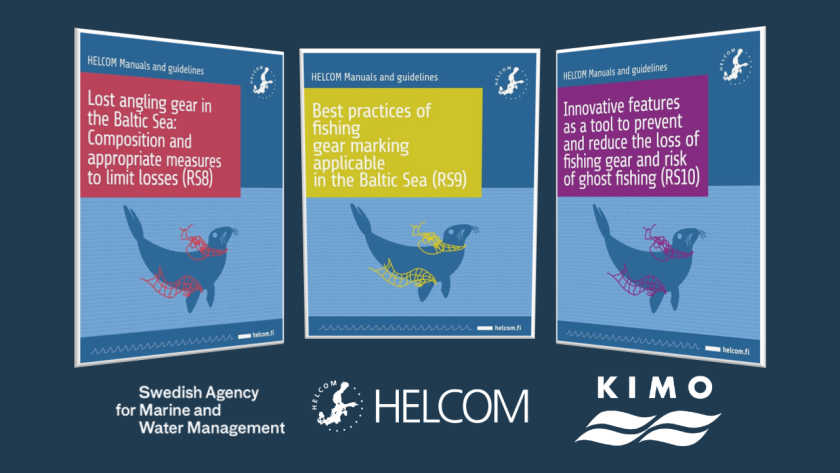
KIMO is pleased to have contributed to three new reports published by the Helsinki Commission (HELCOM), which explore practical ways to address Abandoned, Lost or otherwise Discarded Fishing Gear (ALDFG) in the Baltic Sea.
The reports were authored by Ryan Metcalfe (National Coordinator for KIMO Denmark) , Henrik Vejsgaard Koch (KIMO Denmark) , and independent consultant Magnus Engelbrektsson. They form part of HELCOM’s Regional Action Plan on Marine Litter and aim to provide policymakers and the fishing sector with accessible, evidence-based information on a complex environmental challenge.
Understanding the Issue from Different Angles
Each of the three reports examines a specific aspect of fishing gear loss, bringing together existing research, practical experience, and insights from recent policy developments.
1. Lost angling gear in the Baltic Sea: Composition and appropriate measures to limit losses (RS8)
Recreational fishing is a valued activity across the Baltic region, but it also contributes to marine litter. This report summarises what is known about these losses and considers how recent European legislation may help address them.
What it covers:
– Earlier studies cited in the report suggest that substantial quantities of fishing line, baits, and sinkers are lost each year, though the authors note that such estimates involve considerable uncertainty.
– The report provides an overview of how Baltic countries are implementing relevant EU laws, including the Single-Use Plastics Directive and the revised Fisheries Control Regulation.
– It finds that several countries are implementing extended producer responsibility schemes, under which manufacturers contribute to the costs of collecting and managing end-of-life gear. Some have begun setting collection targets.
– It suggests that these policy frameworks, while still in their early stages, may offer useful tools for reducing gear loss over time.
2. Best practices of fishing gear marking applicable in the Baltic Sea (RS9)
This report looks at how marking fishing gear can help identify its owner—a basic but essential step if lost gear is to be traced and returned, and if patterns of loss are to be better understood.
What it covers:
– It draws on the UN Food and Agriculture Organization’s voluntary guidelines, which represent international consensus on good practice.
– It describes a range of marking methods, from simple durable labels displaying country codes and vessel identifiers, to newer technologies such as RFID tags and acoustic transponders that may assist in locating lost gear.
– It offers practical suggestions on where to mark different gear types—such as gillnets, pots, and trawls—focusing on the parts most prone to being lost.
– Better marking cannot solve the problem alone, but it can help establish accountability and support efforts to recover gear before it becomes a hazard.
3. Innovative features as a tool to prevent and reduce the loss of fishing gear and risk of ghost fishing (RS10)
This report considers whether modifications to gear design might reduce the harm caused if gear is lost—in particular, the continued capture of marine life, known as ‘ghost fishing’.
What it covers:
– It reviews emerging ideas such as the use of biodegradable materials in specific parts of nets or traps, which could eventually break down and create escape routes for marine animals.
– It notes examples where such approaches have been trialled, including Sweden’s requirement that lobster traps include escape openings secured with untreated cotton thread.
– It acknowledges that these ideas are still developing and that questions remain about their practicality, durability, and effect on catch rates.
– The aim is not to offer simple solutions, but to highlight approaches that may warrant further investigation.
A Collaborative Effort
These reports are the result of a partnership between KIMO, the Swedish Agency for Marine and Water Management, and the HELCOM Secretariat. They draw on contributions from a range of individuals and organisations working on marine litter across the Baltic Sea.
“We hope these reports will be a useful resource for those working to reduce the impact of lost fishing gear,” said Ryan Metcalfe. “The issue is complex, and there are no quick fixes. But by bringing together what we know about marking, design, and policy, we can help support informed discussions about the way forward.”
KIMO looks forward to continuing its work with local authorities, researchers, and other partners to support practical efforts to reduce marine litter in the waters around our coasts.