


New guidance recommends practical measures to prevent discarded pieces of fishing nets, rope and cord from entering the marine environment.
KIMO International has reached an important milestone in its work to reduce marine litter, as KIMO’s best practice recommendations on ways to reduce pollution from net-cuttings was adopted as an official OSPAR Agreement, on 25 June 2026 and published in September 2026.
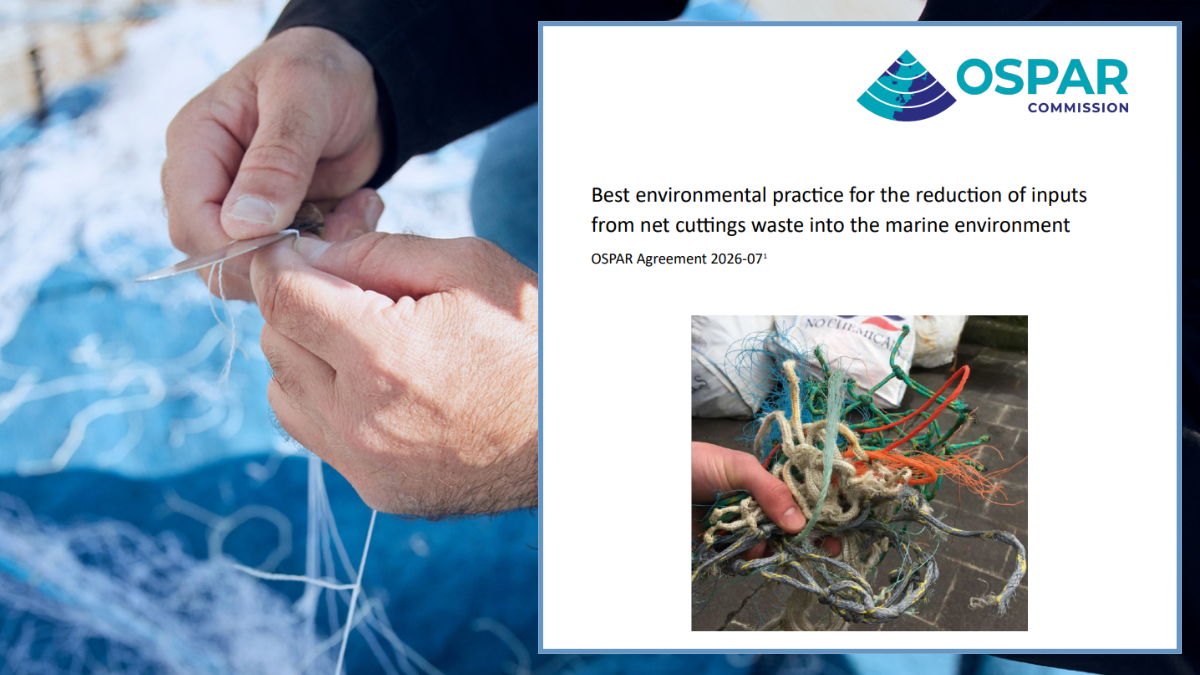
The report was adopted as OSPAR Agreement 2026-07: Best environmental practice for the reduction of inputs from net cuttings waste into the marine environment during the OSPAR Commission’s annual meeting in Ostend, Belgium. Authored by KIMO International, the guidance provides practical recommendations for fishing vessels and ports across the OSPAR Maritime Area to prevent waste generated during fishing net repairs from reaching the sea.
The adoption represents a significant step forward in KIMO’s efforts to tackle an often-overlooked source of marine litter and to translate research and practical experience into measures that can be implemented by fishing communities and port authorities.
Tackling marine litter at its source
Net cuttings are the pieces of netting, rope and cord produced when damaged fishing gear is repaired. Although often small, these fragments can accumulate along coastlines and contribute significantly to marine litter.
The report highlights the importance of this issue in the North-East Atlantic. Between 2018 and 2020, string and cord less than one centimetre in diameter accounted for 24% of beach litter pollution recorded in the OSPAR Maritime Area, according to data cited in the report.
Much of this waste originates from the repair of bottom-trawl nets, both aboard fishing vessels and on quaysides. Small pieces can be blown or washed overboard from vessel decks, while waste left on the ground in ports can be carried into the sea by wind, rainwater and runoff.
Preventing net cuttings from becoming marine litter requires action at the point where the waste is generated. The report identifies straightforward, practical and often inexpensive ways for fishers, vessel skippers and port authorities to improve waste collection, handling and disposal.
Practical solutions for fishing vessels and ports
The guidance is divided into two main sections, addressing measures that can be implemented aboard fishing vessels and in ports.
For fishing vessels, recommendations include:
- Collect and contain waste: Using dedicated bins, containers, bags or wearable pouches to capture net cuttings as repairs take place.
- Introduce systematic cleaning routines: Sweeping work areas thoroughly after repairs and ensuring that cuttings are collected and disposed of correctly.
- Use enclosed repair areas where possible: Reducing the risk of waste being blown or washed overboard during net maintenance.
- Improve onboard waste management: Ensuring that suitable, secure and accessible containers are available and that crews understand how to use them.
For ports, the report recommends measures such as installing raised barriers along quaysides, designating specific areas for net repairs, providing accessible waste containers and cleaning equipment, and introducing regular inspection and cleaning routines.
It also highlights the importance of including net cuttings in port waste management plans, providing clear signage to guide disposal, and raising awareness among fishers. Where appropriate, ports can also use enforcement measures to ensure that waste is collected and managed responsibly.
The report emphasises that cooperation between fishers and port authorities is essential. Solutions should be adapted to local conditions, the facilities available and the practical requirements of fishing operations. Skippers, fisheries associations and port managers all have an important role in encouraging good practice and making sure that effective waste management becomes part of everyday routines.
Building on KIMO’s work with OSPAR
The new OSPAR guidance builds on research and practical work undertaken by KIMO International to understand the sources of net cuttings waste and identify effective ways to prevent it from entering the marine environment.
The report draws on KIMO’s earlier research funded by the Swedish Agency for Marine and Water Management (SwAM) which included surveys of ports in four European countries, alongside discussions with port managers and fishers. This research led to the publication of information resources such as Net cuttings waste from fishing in the North-East Atlantic: Best practices for mitigation and Best Practices to reduce marine litter from net cuttings waste.
The current net-cuttings guidance was prepared as an output of OSPAR’s Second Regional Action Plan on Marine Litter, under Action B.4.3, which promotes practical solutions to reduce the impact of specific fishing-related items, including net cuttings and dolly rope. The action is led by Belgium, Germany, the Netherlands, Sweden and KIMO International, with support from Seas at Risk.
The report was produced by KIMO with contributions and technical input from a wider group of experts and stakeholders and was once again funded by the Swedish Agency for Marine and Water Management (SwAM).
By adopting the guidance as official policy, OSPAR provides its Contracting Parties with a shared set of practical recommendations to support efforts to reduce fishing-related marine litter throughout the region.
Turning guidance into action
The adoption of OSPAR Agreement 2026-07 marks an important achievement for KIMO International and reinforces the value of collaboration between municipalities, fishing communities, port authorities and regional organisations in protecting the marine environment.
Effective implementation of the recommended practices could significantly reduce the amount of net cuttings entering the sea, contributing to OSPAR’s wider objectives to prevent and reduce marine litter and eliminate inputs that harm marine and coastal ecosystems.
KIMO International will continue to support practical solutions that prevent pollution at source and help protect healthy seas and coastal communities.